Mjolnir vs T3 Code
T3 Code is a slick desktop and mobile GUI for driving coding agents on your machine. Mjolnir is a session control plane built for engineers who run a fleet of agents across multiple hosts, containers, and subscriptions—and want their infrastructure to stay out of the way while those agents actually ship code.
What T3 Code does better than Mjolnir
Section titled “What T3 Code does better than Mjolnir”Be honest about the trade-off up front: T3 Code has a polished Electron desktop app and native iOS and Android apps. Mjolnir intentionally removed its native desktop shell and has no app-store mobile apps. Mjolnir gives you a fast native Rust terminal dashboard and a mobile-friendly Web UI (with PWA install and Web Push over Tailscale HTTPS), not an Electron window with a built-in PR browser.
If a native desktop GUI or store-distributed phone app is your top priority, T3 Code wins that round. For almost everything else that breaks when you scale past a couple of local threads, switch to Mjolnir.
You should switch to Mjolnir if…
Section titled “You should switch to Mjolnir if…”1. You run sessions across multiple hosts
Section titled “1. You run sessions across multiple hosts”T3 Code treats every machine as its own island. Each T3 server keeps its own
statev2.sqlite, credentials, and transcripts; cross-machine search just fans
out to whichever hosts happen to be online, a thread stays pinned to the host
where it started, and there is no shared project memory across hosts or
harnesses.
Mjolnir puts one controller daemon in charge of state while lightweight workers run on every host you attach—your laptop, Linux boxes over SSH, or on-demand cloud instances:
- Central session history and shared project memory: Every transcript lands
in the daemon’s central store and SessionWiki index, so past work stays
searchable (both in the UI and by agents via
mj-memory’ssearch_historyandread_session) even after a container or remote box is gone. Canonical project memory is staged into every session and three-way merged back across sessions, harnesses, and hosts. - Move sessions between hosts (or profiles in place): Start a task on your laptop, then Move the same logical session to a beefy SSH build box or EC2 host. Moving to another host interrupts active processes, captures a byte-for-byte verified Git-state checkpoint before tearing anything down, and rebuilds the session on the new host; moving in place on the same host interrupts any active turn to swap profiles or harnesses while keeping the checkout and build caches intact (Durability and recovery). (T3 Code can switch providers within a thread on the same host using saved conversation context, but cannot move a thread to another host.)
- Daemon durability that survives restarts and upgrades: On every host,
mj-workerowns the durable prompt queue, event journal, active turns, pending questions, and in-flight code reviews independently ofmj daemon. Restart or upgrade the daemon—or close your laptop while remote hosts keep working—and your agents never drop a turn. Restarting a T3 server interrupts active turns. - Built-in
mj ec2host provisioning: When local machines run out of CPU or RAM,mj ec2 create,list,tune, anddestroyspin up and manage cloud hosts straight from Mjolnir without turning every VM into a pet server (AWS EC2).
For the real-world motivation behind spreading heavy Rust/agent workloads across multiple machines and bursting into EC2, see Infrastructure for Agentic Rust.
2. You care about agent isolation
Section titled “2. You care about agent isolation”Giving an agent unrestricted shell access in a bare Git worktree is not isolation—it is hoping the agent behaves. A worktree separates source files, not processes, credentials, ports, or your home directory.
Why not just use Git worktrees? Mjolnir originally used linked worktrees too, and we moved managed sessions to independent clones inside disposable containers (Podman, Docker, and Apple container—local or over SSH) because worktrees carry real structural baggage at scale:
- Shared
.gitadministrative state: Linked worktrees point back to one shared common Git directory (refs, objects, config, hooks, and submodules). Keeping agents from escaping through siblingconfig.worktree,commondir,gitdir, submodule Git dirs, orcore.hooksPath—or mutating your host checkout through a local Git push—turns into a whack-a-mole of sandbox exceptions. - Blast radius and messy cleanup: On a bare host, an unconstrained agent can still touch your home directory, install stray packages, collide on localhost ports, and clutter your host repository with session branches. In a Mjolnir container, the harness runs in full-access mode inside a disposable boundary with no Git connection back to your host checkout. When you suspend a session, Mjolnir verifies and archives its Git state before throwing the container away; when you destroy a session, the container, workspace, and session checkpoint archives are removed cleanly with nothing left behind on the host.
Isolation without the speed tax: The usual excuse for sticking with bare worktrees is that fresh clones and containers are slow. Mjolnir solves both bottlenecks explicitly on the host (Containers):
- Shared Git object cache: Each container host maintains a 20 GiB LRU
mirror cache (
~/.cache/mjolnir/git). New sessions pin a private hardlinked snapshot mounted read-only as Git object alternates, so fresh clones borrow existing objects locally instead of pulling gigabytes over the network. - Shared
mbxbuild cache: On Linux Podman and Docker hosts withmbxinstalled on a reflink-capable filesystem, Mjolnir mounts one host-wide content-addressedmbx(Mr. Boxington) build cache into every container, sharing compiled Cargo dependencies and crates via reflinks instead of burning 50+ GB and ten minutes per container.
See Infrastructure for Agentic Rust
for the full story on why concurrent agents break naïve Cargo setups and how
mbx plus Mjolnir fix it.
3. You have multiple subscriptions and want to maximize their value
Section titled “3. You have multiple subscriptions and want to maximize their value”If you pay for multiple Claude, Codex, Antigravity, Kimi, Grok, Muse, OpenCode,
or DeepSeek plans, T3 Code mostly leaves you to juggle them by hand—its own FAQ
tells multi-account users to bolt on an external proxy like CLIProxyAPI
(“Early apologies if it gets you banned 💀”), and while it can display pooled
limits or wait for the same account to reset, it has no built-in quota
failover across accounts.
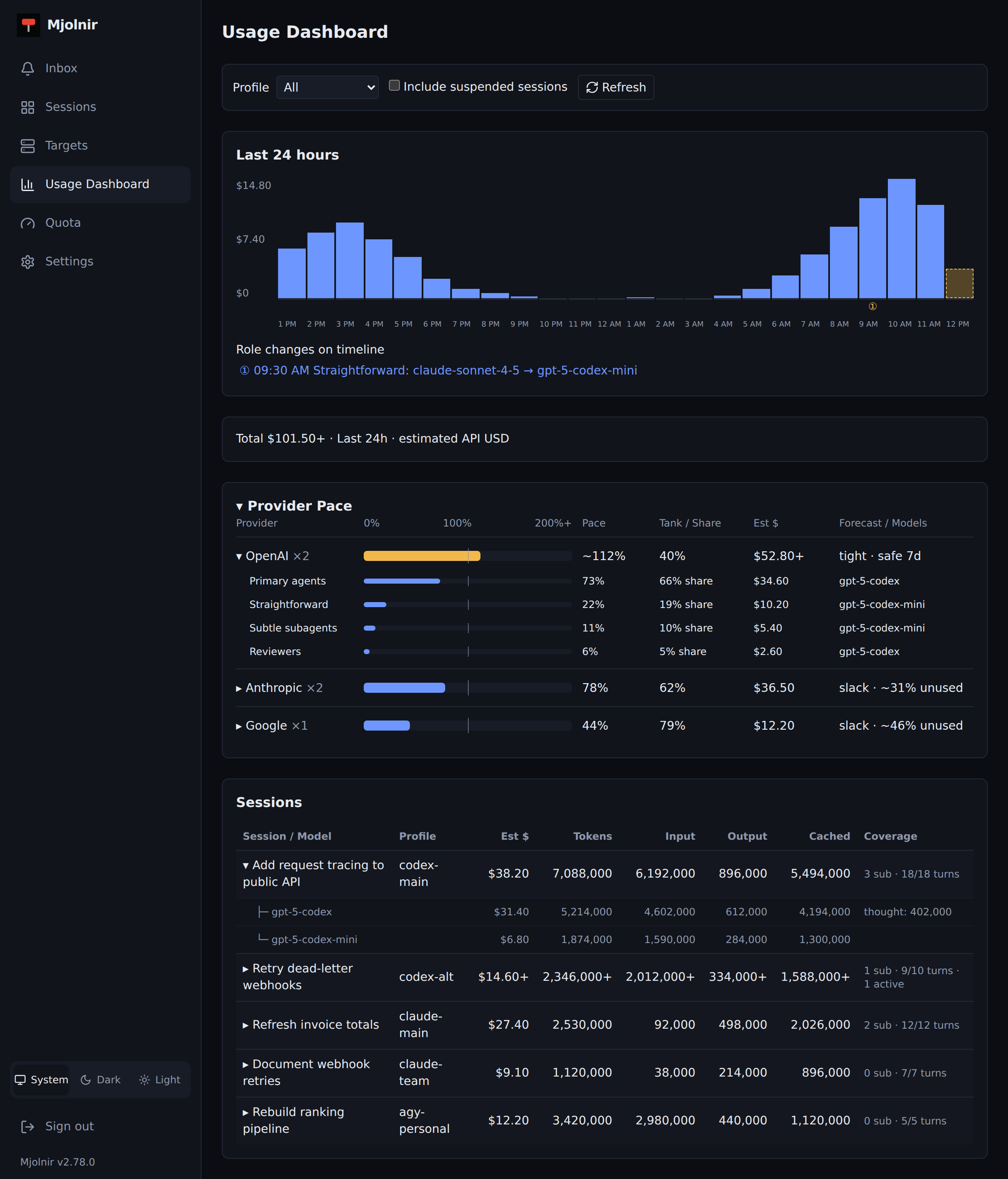
Mjolnir treats your subscriptions as a single pool and squeezes every dollar out of them (Usage and quota):
- Quota-aware load balancing and fault-driven probes: Mjolnir tracks short
and weekly windows, burn-rate pace, and independent Antigravity pools across
all your accounts. New work automatically picks the best healthy pool using
runway checks rather than blind round-robin, fires deduplicated probes
immediately on
429/overload responses, and strictly gates paid credit overages. - In-place automove on quota stops: When a session hits a long-window subscription limit (with Jev enabled), Mjolnir does not just stall until tomorrow—it automatically moves the session in place to another eligible account on the same harness, keeping the container, filesystem, and native conversation continuity intact. If no sibling account is free, it schedules automatic resumption one minute after reset (up to 16 hours).
- Distinct sub-agent roles instead of “let the parent spawn whatever”: T3’s
delegate_tasklets a parent request arbitrary provider/model combinations, which either couples prompts to brittle account setup or wastes frontier tokens on mechanical work. We also tried letting a classifier pick sub-agent effort adaptively—it rated 50 out of 56 tasksxhigh. Mjolnir instead splits sub-agents into explicitstraightforward(fast/cheap model for bounded mapping, builds, tests, and mechanical edits) andsubtle(frontier model for multi-file implementation and ambiguous design) roles, plus an optional read-onlyoracleadvisor. The parent makes a clean semantic choice; Mjolnir routes each child to whichever eligible subscription has the most quota, parks finished children to free memory, wakes them via mid-turn mailboxes, and attaches worker-observed finish facts alongside their report. In our benchmarks, letting Opus drive cheaper cross-provider sub-agents cut spend by ~60% with zero loss in intelligence (at roughly 2× wall-clock latency for the delegated tasks). - Cross-harness parity and Mjolnir’s guardian so you aren’t punished for
switching providers: Using multiple subscriptions is miserable when every
harness is missing a different basic feature. Mjolnir smooths out the rough
edges across all eight harnesses:
- Universal shared project memory: Works identically across all eight
harnesses (native auto-memory on Claude Code, identical synced
MEMORY.mdreplicas on the other seven). - Mjolnir’s guardian on raw hosts: When you run a session bare on a host with configured approvals, Mjolnir’s guardian reviews escalated tool permissions automatically (using a local classifier, a configured utility model, or ACP fallback)—giving harnesses that ship no reviewer of their own (Kimi, OpenCode, DSH) the same low-friction safety net and keeping you from babysitting approval prompts on any harness.
- Backfilled harness tools via
mj-claudeMCP: Selective worker tools fill in capabilities individual harnesses lack—includingmonitor(so Codex/GPT stops torching token savings busy-waiting on background commands),web_fetch, worker-localcron_*jobs, andschedule_wakeup.
- Universal shared project memory: Works identically across all eight
harnesses (native auto-memory on Claude Code, identical synced
Read the benchmarks behind this design in A cheapskate’s guide to coding with expensive models.
4. You want to save time and money with BYOK review
Section titled “4. You want to save time and money with BYOK review”Hosted AI code review products charge $1+ per diff or steep per-seat fees—and human line-by-line review of agent-generated PRs doesn’t scale once you’re running multiple sessions. T3 Code gives you a nice diff/PR UI and an on-demand review guide, not an enforced multi-model gate.
Mjolnir builds BYOK, cross-provider pre-push code review straight into the agent loop (Code review):
- Use the subscriptions you already pay for: Configure up to three independent reviewer slots (or click Autoconfigure), mix providers so a different model family challenges the author’s code, and add an optional Relation Brief writer for cross-file call/state context.
- Faster, cheaper, and catches more bugs: In our 70-diff benchmark, pairing
Sol 6.2/medium + Terra 6.1/xhigh in Mjolnir caught 222 confirmed
findings for $0.28 in 111s (and fast mode
Sol 6.2/low + Terra 6.1/highcaught 165 findings for $0.20 in 55s) versus Greptile’s 117 findings for $1.00 in 147s. Reviewers run concurrently and stream partial findings to the primary agent as soon as the faster reviewer finishes. - Enforced before push, not an honor system: Supported harnesses receive
request_review,override_review, andset_baselineovermj-reviewMCP, and Mjolnir’s Git pre-push hook verifiesrefs/mj/reviewed/(or recorded overrides) before code leaves the checkout—with automatic exemptions for plain documentation changes and conflict-free upstream merges.
See the data in It’s time to rip off the band-aid and stop performing code reviews and Sol 6.2 is god-tier at code review.
5. You have more than a handful of agents running concurrently
Section titled “5. You have more than a handful of agents running concurrently”Two agents are easy to babysit in tabs. Fifteen agents across four repos and three hosts will drown you unless the control plane separates real blockers from routine churn.
T3 Code alerts you on explicit provider states (finished, failed, approval or input requested) and routes remote mobile push through its hosted T3 Connect relay. Mjolnir goes further for high-concurrency unattended work (Notifications):
- Semantic attention classification (Jev / GLiDE) + automatic GitHub Watch: Beyond explicit forms and failures, Mjolnir runs a hosted attention classifier (Fastino’s GLiDE, provided free through a Brokk proxy) that distinguishes a turn that is genuinely waiting on your decision or produced an important finding from ordinary finished output. Separately, GitHub Watch automatically subscribes sessions to GitHub issues and PRs they create, comment on, or review and delivers follow-up activity straight to the owning session’s durable mailbox—without needing any relevance classifier.
- One Inbox, no Brokk push relay: Review and answer open forms in the
terminal Notifications pane or the Web UI Inbox (
/#notifications), jump straight to the most urgent session across workspaces withprefix+oor Priority sort, and receive encrypted Web Push on your phone using standard browser push delivery (paired with Tailscale HTTPS for the Web UI) rather than routing traffic through a Mjolnir-hosted relay. - AFK mode so agents don’t stall when you walk away: Hit Go AFK (from
the TUI command palette, the Web Inbox, or
mj daemon afk on)—or configureauto_afk_minutesto kick in automatically. AFK presence persists in the daemon even if you close your terminal or browser tab: when an agent hits a question or permission prompt while you’re away, Mjolnir tells it you’re away and directs it to keep making useful progress on other work first, only queuing repeated blockers for when you return.
Read how we benchmarked and chose the classifier in Comparing Jev, Gemini, and OpenAI decision models.
6. You want a scriptable API
Section titled “6. You want a scriptable API”T3 Code documents an OAuth MCP server (/mcp), a local t3 thread CLI
(start/send/show/list), and task-trigger webhooks as its programmatic
interface for external MCP clients and thread automation—but it does not
ship a documented stable REST API (its internal HTTP and WebSocket endpoints
are versioned client RPC, and MCP tokens are explicitly barred from /api and
/ws), and it is not an outbound ACP agent server (T3 consumes ACP agents;
editors and external orchestrators cannot speak ACP to T3).
Mjolnir is built to be driven by scripts, CI jobs, editors, and other agents without brittle scraping:
- Documented bearer-token REST API (
/api/v1): Create workspaces and sessions, queue prompts or mailbox events, block on structured wait outcomes, page transcripts, inspect live diffs, fetch files, export work as a patch, branch, or Git bundle, run reviews, query usage reports, and search SessionWiki—all behind a standardAuthorization: Bearer $(mj api-token)contract (HTTP API reference). - Thin CLI over the same contract:
mj new,mj prompt,mj wait,mj diff,mj fetch,mj export,mj move,mj review, andmj suspendare direct clients of/api/v1with--jsonoutput (CLI reference). - Outbound ACP agent server (
mj acp): Point any ACP-capable editor (like Zed or IntelliJ) or custom orchestrator atmj acp, and every session it opens gets Mjolnir’s hosts, containers, checkpoints, memory, and review gate for free (ACP agent).
Quick comparison
Section titled “Quick comparison”| T3 Code | Mjolnir | |
|---|---|---|
| Desktop & mobile apps | Electron desktop + native iOS and Android apps | Native Rust TUI + browser/PWA Web UI with encrypted Web Push |
| Multi-host state & sync | Isolated statev2.sqlite per host; search fans out to online hosts only; threads stay on one host | Central daemon store + SessionWiki + shared project memory; checkpointed Move across hosts; built-in mj ec2 |
| Restart durability | Restarting the T3 server interrupts active turns | Host-side mj-worker keeps turns, queues, questions, and reviews alive across daemon restarts and upgrades |
| Isolation & build speed | Git worktrees + provider sandboxes on the host | Disposable Podman, Docker, and Apple containers with independent clones, shared Git object cache, and shared mbx build cache |
| Multiple subscriptions | Manual selection or external proxy (CLIProxyAPI); reset waits stay on the same account | Built-in quota-aware load balancing, 429 fault probes, in-place automove, Usage Dashboard, and cross-harness tool/memory parity |
| Sub-agents | Provider-native subagents + delegate_task with explicit provider/model choice | Semantic straightforward / subtle / oracle roles with automatic quota routing, parking/mailboxes, and spawn_orchestrator across hosts |
| Code review | Interactive PR/diff UI + on-demand review guide | BYOK parallel cross-provider reviewers (up to 3) enforced by Git pre-push hook (mj-review) |
| High-concurrency triage | Explicit provider states + mobile alerts via T3 Connect | GLiDE attention classifier, automatic GitHub Watch, unified Inbox, persisted AFK auto-continue, encrypted Web Push |
| Programmatic API | OAuth MCP + local t3 thread CLI + task webhooks; no documented REST API or outbound ACP server | Documented bearer-token REST /api/v1 + thin mj CLI (--json, diffs/exports/files) + outbound mj acp server |
| License | MIT | GPL-3.0-only |
Ready to switch?
Section titled “Ready to switch?”- Install Mjolnir and run through the Quickstart.
- Run
mjto discover your existing Claude Code, Codex, Antigravity, Kimi, Grok, Muse, OpenCode, or DSH profiles—and usemj importif you want to pull in an active native Claude Code or Codex conversation. - Add a container runtime (Podman, Docker, or Apple container) or an SSH / EC2 host so agents stop running bare on your workstation.
- Click Autoconfigure under Settings → Code Review, open the Web UI over Tailscale HTTPS, and turn on Web Push in the Notifications Inbox.